
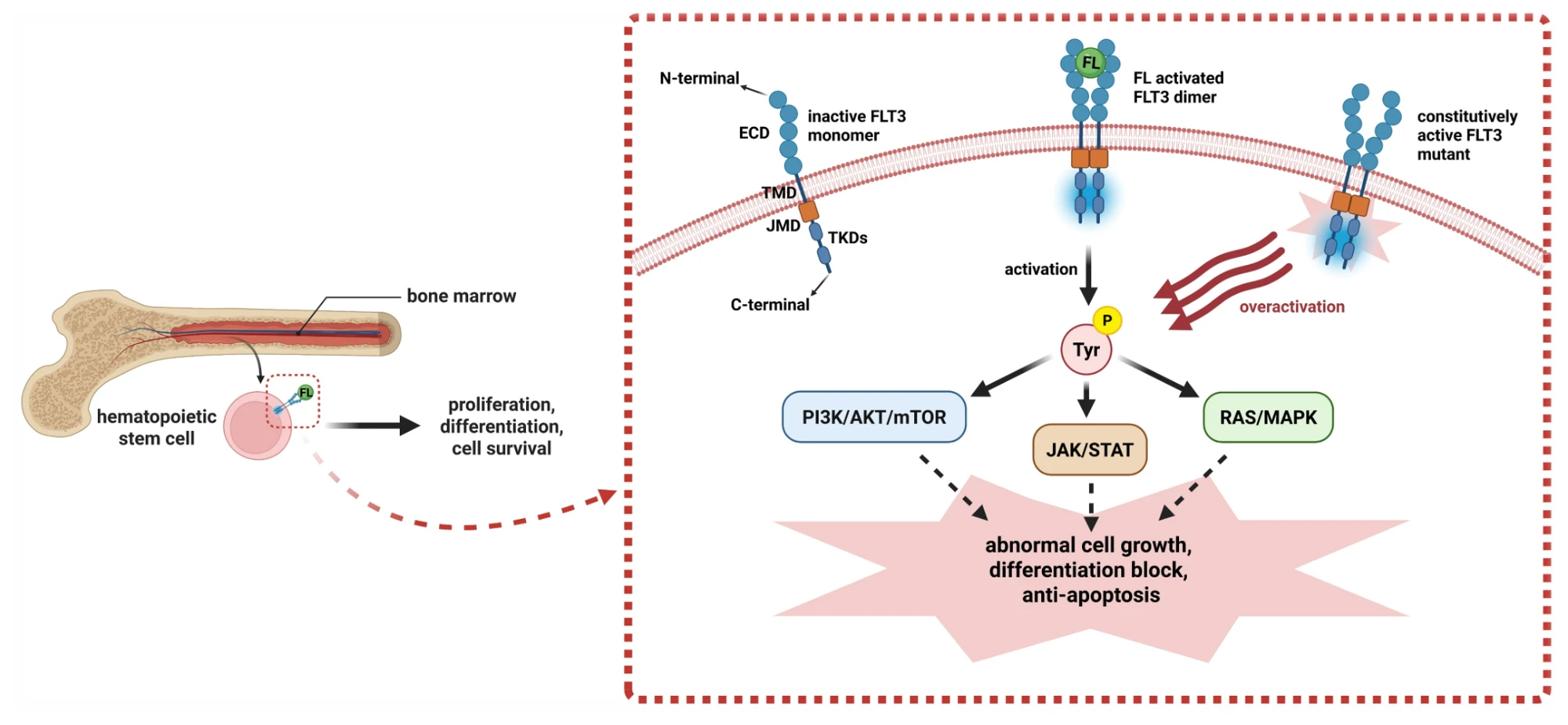
Acute myeloid leukemia (AML) is aggressive and carries a poor prognosis, with roughly 30% five-year survival. Around 30% of AML cases are driven by an FLT3 mutation (FLT3-ITD/TKD) causing constitutive signalling — a clear, testable biomarker. Approved FLT3 inhibitors such as midostaurin and gilteritinib are limited by selectivity, acquired resistance and adverse effects that lead to discontinuation, leaving room for a better-tolerated, resistance-aware agent.
We developed 27 multi-fragment heterocyclic FLT3 inhibitors built on 7-azaindole / aminopyridine scaffolds, designed for precise H-bonding, selectivity and solubility, and produced through scalable synthesis (reductive amination, Suzuki–Miyaura coupling). The compounds show sub-micromolar IC₅₀ in FLT3-mutant cell lines while remaining selective against non-mutated cells.
Evidence to date
| Compound | FLT3-ITD IC₅₀ (µM) | MV4-11 GI₅₀ (µM) | LLE |
|---|---|---|---|
| Lead K1872 | 1.26 | 0.79 | 4.7 |
| Compound 47 | 0.096 | 0.32 | 6.9 |
| Compound 48 | 0.092 | 0.36 | 7.5 |
| Compound 60 (in vivo candidate) | 0.163 | 0.16 | 8.9 |
- Selectivity — 139-kinase panel: FLT3-ITD 0.18 µM vs. FLT3-WT 0.32 µM, JAK2 0.60 µM, RET 1.1 µM.
- Tolerability — NOAEL > 15 mg/kg in mice, maintained on repeated 5+2 dosing over two weeks.
- ADME — microsomal t½ > 1000 min; plasma stability 97% at 120 min for compound 60.
Positioning options include first- or second-line treatment, combination therapy, or use in the resistance setting after current inhibitors fail. Development has progressed from fragment-based design through synthesis of 27 derivatives and in vitro proof of concept, and is currently in lead optimization / ADME, ahead of planned in vivo efficacy testing (MV4-11 xenograft) and an IND-enabling toxicology package.
A PCT patent application was filed on 26 November 2025, covering composition of matter, synthesis, formulations and therapeutic use in FLT3-mutated AML. The technology is IP-protected and open to licensing, co-development of a clinical candidate, or spin-out.
Co-funded by the European Union — project OncoPharm (CZ.02.01.01/00/23_021/0008442).
Team of Inventors
L. Górecki, M. Čečková, M. Řezáčová, J. Korábečný, D. Muthná, J. Rataj
University Hospital Hradec Králové · Charles University (Faculty of Medicine and Faculty of Pharmacy in Hradec Králové)