Background
Manual muscle-testing and the use of a dynamometer are the most common methods to measure muscle strength. Currently used methods of semi- and quantitative measurement of maximal muscle strength require subject cooperation and thus depends on engagement of tested subject.
Measuring muscle strength may be an important component of physical training or nutrition evaluation and assessment.
Descricption of the Invention
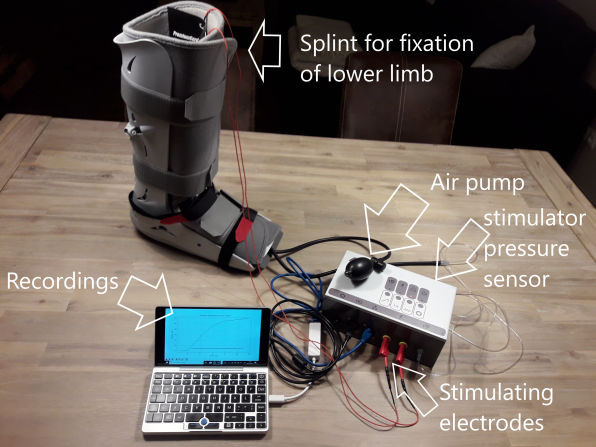
The lack of quantitative data of muscle strength resulted in the development of our device. Our solution is objective dynamometry. The device works on the principle of electrical stimulation of the musculus tibialis at the motor point by a series of stimulation with increasing intensity. The maximum muscle strength and muscle fatigue are determined from the measured values using torque sensor based on tensometric measurement. This noninvasive approach enables appropriately investigating the characteristics of muscles and assess distribution of fast and slow muscle fibers. Our device is intended not only for sports medicine (effect of training and nutrition on athletes’ performance) and for athletes themselves, but also for intensive medicine (sarcopenia, coma, long-term diseases). We have developed a prototype of second generation according to regulations that are required to follow for devices of such type.
Advantages
Currently, the devices on the market are based on dynamometric principle engaging human will. Our device operates objectively independently of human will. Our device is mobile, simple and easy-to-use. Our device is a suitable tool to screen for sarcopenia and identify effective ways for preventive and therapeutic interventions and thus prevent the disastrous consequences of sarcopenia. Moreover, our solution offers technique that teaches athletes how to improve their health and physical performance.
Technology is owned by University Hospital Hradec Králové and company MEBSTER s.r.o.. Technology is protected with know-how. Non-medical prototype was develop and is now being tested. The development was supported by the Technology Agency of the Czech Republic within the programme for applied research, experimental development and Innovation GAMA - Project TG02010020 - Centre for Transfer of Biomedical Technologies - PoC and GAMA 2 – Project TP01010034 – Centre for Transfer of Biomedical Technologies – PoC2.
Team of Inventors
prof. MUDr. Zdeněk Zadák, CSc.
University Hospital Hradec Králové
Head of the Department of Research and
Development
Principal investigator & coinvestigator of multiple research projects and clinical studies
Specialization in artificial nutrition, metabolic diseases, intensive care and gerontology
Honorary member of 9 domestic and foreign professional societies
Honorary chairman of the Society of Clinical Nutrition and Intensive Metabolic Care of the Czech Medical Association J. E. Purkyně
Member of 10 editorial boards and advisory
boards of domestic and foreign journals
Author of 11 books, 14 patents, 12 utility models, 1 prototype
Published 150 professional articles in foreign renowned journals (total IF 427.7), cited in world literature (1430 citations ISI Web of Knowledge)
Prof. MUDr. Martin Vališ, Ph.D., FEAN
University Hospital Hradec Králové
Head of Clinic of Neurology (UH HK)
Head of Department of Neurology (MF CU HK)
Publications with IF: 240, WOS 4900
Committee Member of the Section of cognitive neurology and neuroimmunology (CNS-CzMA)
Committee Member of the Alzheimer’s Foundation–CR
Fellow of European Academy of Neurology
Principal investigator & coinvestigator of multiple research projects and clinical studies