
Video — see it in action
Multiple sclerosis (MS) is the most common cause of neurological disability in young and middle-aged people. MS has a physical, psychological and financial impact on patients and their families. Up to 85 % of patients with MS identify gait disorders as a major problem. The ability to monitor the development of the disorder over time is highly valued diagnostic measure. Falling because of old age, neurological disorders, movement disorders and injuries can be predicted by the assessment of change in gait quality.
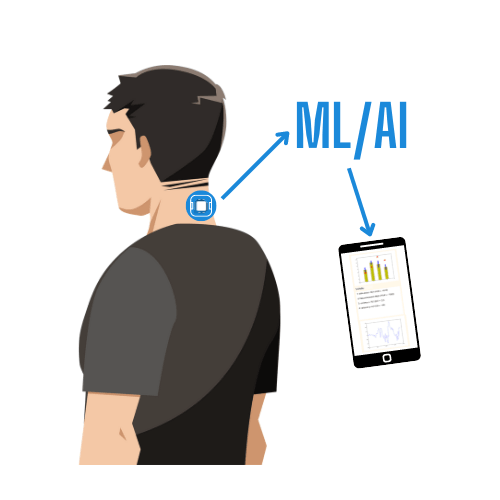
A set of wearable sensors and the first computing unit – assessing the overall gait quality in real time while walking, providing immediate feedback to the user or the physician. Subsequently, the second unit identifies several gait disorders, their extent and probable cause. In both cases, the evaluation is performed using machine learning modules. Both approaches show relatively great robustness of the approach used and the relative simplicity of computer performance, especially in the near future. For general use the first step processing can warn patients or elderly people on the probability of falling.
Easy to Use
Simple, easy to use, yet reliable and robust diagnostics.
Automatic Evaluation
Automatic evaluation – no expert needed for daily use of a patient but may work as a decision support for expert physician - neurologists.
Normal Activity Use
No laboratory assessment distortion, but real world – normal activity view.
One Sensor
No multiple joint sensors and expensive SW/HW needed ‑ just one sensor unit well positioned.
Worldwide increasing incidence of MS was estimated to be 2.8 million people in 2020, in developed countries is double to triple incidence ‑ it might be due to lack of qualified diagnostics available in the developing countries ‑ the numbers are therefore supposedly undervalued. Can be helpful for many other neurological or movement diseases and elderly in general. Technology is owned by University Hospital Hradec Králové . Czech patent application PV 2021-331 and PCT application PCT/CZ2022/050062 (priority 30. 06. 2022) was submitted. Prototype testing in progress .
Company/co‑development partner to bring technology to market as MD/Diagnostics and/or as a general public “indicative” device to warn about the risk of falling.
Seeking for development partner, commercial partner or licencing.
-
Non-MD/Diag. device – wearable “fall prediction”
-
Diagnostic – wearable – good/bad gait indicator
-
Diagnostic – wearable + mobile/tablet - gait disorder type and severity analyser and classifier.
Team of Inventors
Assoc. prof. Oldřich Vyšata & team
University Hospital Hradec Králové
Neurological clinic, University Hospital Hradec Králové
Investigator & coinvestigator of multiple grants
Author & coauthor of more than 120 papers in prestigious international journals
prof. MUDr. Martin Vališ, Ph.D., FEAN
University Hospital Hradec Králové
Head of Clinic of Neurology (UH HK)
Head of Department of Neurology (MF CU HK)
Publications with IF: 240, WOS 4900
Committee Member of the Section of cognitive neurology and neuroimmunology (CNS-CzMA)
Committee Member of the Alzheimer’s Foundation–CR
Fellow of European Academy of Neurology
Principal investigator & coinvestigator of multiple research projects and clinical studies
HTML Website Maker