Video — see it in action
Background
Fracture of a tooth-root tip during extraction is a common complication. Retained root fragments are reported in approximately 11–37 % of cases, and dental emergency and urgent-care settings encounter this issue several times a day. It is estimated that 13 % of adults aged 30+ have at least one retained root fragment.
The current gold standard — the surgical approach — involves a change of instrument setup, flap elevation and removal of alveolar bone, increasing procedure time, patient discomfort and clinical risk.
Description of the Invention
The invention is a drill-compatible extraction tool with a dedicated pulling adapter, designed to remove broken tooth-root fragments using equipment already available in a standard dental chair setup.
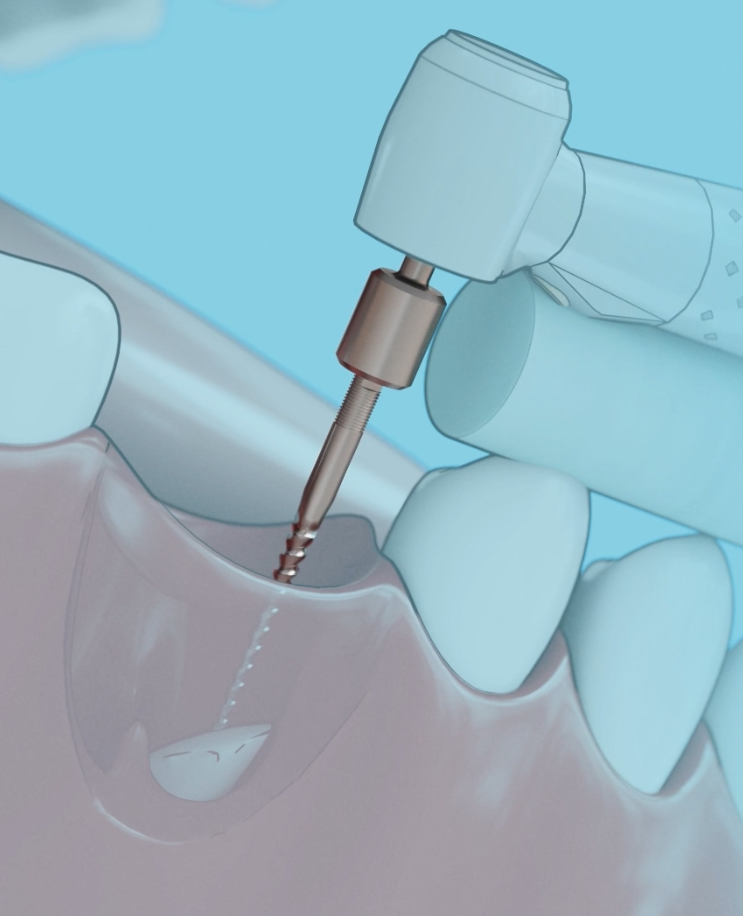
The extraction tool is inserted into a dental handpiece and guided into the root canal. Its specially designed threaded and flexible working section anchors securely within the root fragment, regardless of size or shape. After anchoring, the tool is detached from the handpiece and connected to a dedicated extraction adapter. Controlled low-speed rotation converts rotational motion into axial pulling force, enabling safe and reliable extraction of both the instrument and the root fragment.
Advantages
- Minimally invasive — reduces or eliminates the need for flap elevation and bone removal
- No pre-drilling required — “drill only once”; anchoring is achieved in a single step, preventing weakening of already compromised root walls
- Compatible with standard dental chair setups — compact toolkit usable with most dental handpieces worldwide
- Virtually no learning curve — builds on skills most dentists already possess
- Compact and easy to deploy — no bulky, dedicated extraction systems needed
- Versatile and universal — suitable for curved or straight canals and fragments of various sizes; the tool is self-navigating and self-centering within the root canal
For dentists — reduced setup and procedure time, lower storage requirements, simplified cleaning and no capital investment, without impacting subsequent implant placement.
For manufacturers — low production investment and unit cost; disposable design; established regulatory pathway (similar to endodontic instruments).
Potential Application
General dentistry, oral surgery, implantology and pre-implant extraction, dental emergency and urgent care, dental education and specialty training.
Ownership & IP
Technology is owned by University Hospital Hradec Králové. Czech patent application PV 2026-279 was filed on 21 May 2026; a PCT application is planned. The technology is at the prototype validated stage.
Team of Inventors
Jakub Suchánek · Jan Schmidt · Tereza Suchánková Kleplová — University Hospital Hradec Králové.