
A pseudomeningocele is an abnormal collection of cerebrospinal fluid that most commonly occurs following neurosurgical procedures or trauma. It manifests as swelling around the surgical incision, headaches, and possibly cerebrospinal fluid leakage or pressure on surrounding structures. Conservative treatment consists primarily of observation and the application of a compression bandage.
In current clinical practice, elastic bandages or mesh compression sleeves are used. However, these devices often do not provide sufficient compression to the affected area, tend to slip, and require frequent re-dressing — leading to higher material consumption, increased time requirements for healthcare personnel, and limited applicability in home care.
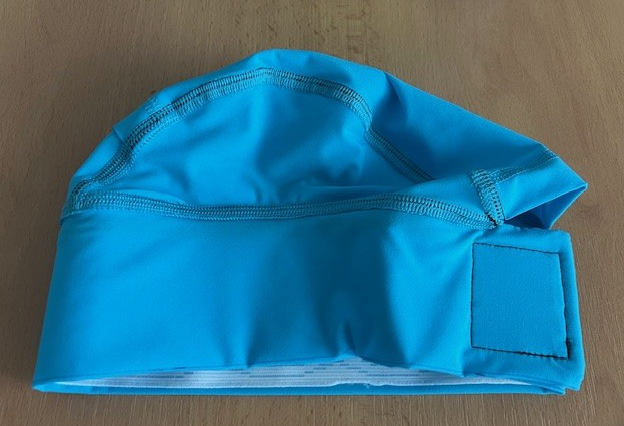
The compression cap is a medical device designed to eliminate or at least significantly reduce postoperative or post-traumatic accumulation of cerebrospinal fluid in the subcutaneous tissue. It is designed to provide uniform and long-term stable pressure to the area of the head requiring compression.
The device consists of an elastic upper section anatomically adapted to the shape of the head and an adjustable fastening strap. The fastening strap is equipped with a silicone layer that increases adhesion to the skin and also features a Velcro system that allows for individual adjustment of size and compression. Thanks to this design, the cap stays securely on the head, does not slip, and maintains the desired compression effect for a long time.
Using the device is simple. After placing it on the head, the fastening strap is tightened to the desired fit and secured with the Velcro fastener. This creates continuous compression on the crown, forehead, temples, and back of the head without the need for repeated application of bandages.
The compression cap is primarily intended for patients with postoperative pseudomeningocele in neurosurgical settings, but it can also be used for other conditions requiring long-term and reliable compression in the head area.
Advantages and potential uses
- Easy and quick to put on.
- Constant and even compression of the target area.
- High stability on the head and minimal slippage.
- Simple adjustment of size and compression force.
- Lower consumption of medical supplies compared to traditional compression bandages.
- Saves medical staff time during dressing changes.
- Can be used in both hospital settings and home care.
- Improves patient comfort and increases the effectiveness of conservative treatment for pseudomeningocele.
Thanks to its design, it offers an innovative solution to the problem of postoperative cerebrospinal fluid collections, for which no specialized device has yet been described that meets the requirements for effective, stable, and long-term compression.
Czech utility model No. 39316, filed on 20 March 2026. Technology development stage: prototype testing completed.
Inventor
Jakub Adámek, B.A.
University Hospital Hradec Králové